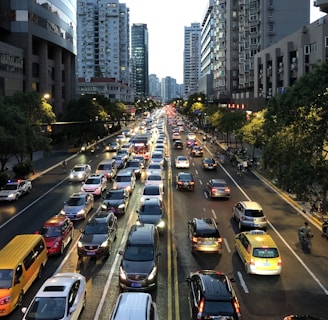


How Traffic Increases City Temperatures: Causes, Effects, and Solutions
LIFESTYLE
4/12/2026
WARM-UP
Answer quickly. No right or wrong answers.
Do you think traffic is a big problem in cities?
Do you think cars affect the environment?
Does hot weather affect your daily life?
VOCABULARY
Essential (A1–B1)
produce – to make something
Example: Cars produce heat.
measure – to find the size or amount of something
Example: Scientists measure temperature changes.
estimate – to guess a number or amount
Example: Experts estimate future temperatures.
climate – the usual weather in a place
Example: The climate is getting warmer.
model – a system used to study something
Example: Scientists use a model to study weather.
make a difference – to have an effect
Example: Small changes can make a difference.
Developed (B2–C2)
produce – to create something as a result of a process
Example: Vehicles produce heat that affects cities.
measure – to calculate or determine accurately
Example: Researchers measure temperature variations in urban areas.
estimate – to calculate approximately
Example: Scientists estimate the long-term effects of traffic.
climate – long-term weather patterns
Example: Urban climate is influenced by human activity.
model – a representation used for analysis
Example: Climate models help predict future trends.
make a difference – to significantly impact a result
Example: Reducing traffic can make a difference in city temperatures.
READING
Introduction
“Traffic does more than cause noise and pollution. This text explains how it can increase temperatures in cities. Read and focus on the main ideas.”
(Read at your level. Do not translate every word.)
Article (All Levels)
Cars produce heat in cities. This heat can make temperatures higher.
Scientists want to measure how much traffic affects temperature.
They estimate that traffic can make cities warmer.
This can affect the climate and daily life.
Developed Article (B1–C2)
Vehicles produce heat that contributes to rising urban temperatures. Researchers use advanced tools to measure and estimate this impact.
By using a climate model, scientists can analyze how traffic affects both outdoor and indoor temperatures.
Although the increases may seem small, they can make a difference, especially during hot weather, and influence the overall urban climate.
COMPREHENSION CHECK
(Answer based on your level.)
A1–A2
What do cars produce?
Do scientists try to measure temperature?
Does traffic affect cities?
B1–B2
Why do scientists measure traffic heat?
How do researchers estimate temperature changes?
What tool do they use to study the climate?
C1–C2
How does traffic produce heat that affects cities?
Why is it difficult to measure the impact of traffic?
How can small changes make a difference in urban climate?
SPEAKING
(Choose a question level.)
A1–A2 — Foundation
Tip: Use sentence starters for all personal questions. It encourages structured, fluent speech.
(Answer + 1 reason)
“I think ___ because ___.”
“One problem is ___.”
“I feel ___ because ___.”
“This makes a difference because ___.”
Personal Questions:
Do you think traffic is a problem in your city? Why?
Do cars produce pollution in your area?
Is the climate hot where you live?
Do you notice temperature changes in summer?
Do you think traffic makes cities hotter?
Do you like driving or walking more?
Do you think small changes can make a difference?
Do you use public transport often?
Is traffic worse now than before?
Do you feel comfortable in hot weather?
Do you think cities are too crowded?
Do you prefer living in a city or countryside?
Do you worry about climate change?
Do you think electric cars help the climate?
Do you think people should drive less?
B1–B2 — Expansion
Tip: Use sentence starters for all personal questions. It encourages structured, fluent speech.
(Answer + reason + 2 details)
“I feel ___ because ___; for example, ___ and ___.”
“One issue is ___, which affects ___ and ___.”
“I think ___ because ___; in particular, ___ and ___.”
“This makes a difference because ___ and ___.”
Personal Questions:
Why do cars produce heat in cities?
How can scientists measure temperature changes?
Why do experts estimate climate impact?
How does traffic affect the climate in cities?
Do you think small changes can make a difference?
How does traffic affect your daily life?
What transport changes would improve your city?
Do you think electric cars will reduce heat?
How can governments reduce traffic problems?
How does heat affect productivity?
Do cities need better planning? Why?
How can public transport improve conditions?
How does traffic affect buildings and indoor temperatures?
What role does technology play in solving climate issues?
Do benefits of cars outweigh the environmental cost?
C1–C2 — Depth & Reflection
Tip: Use sentence starters for all personal questions. It encourages structured, fluent speech.
(Reason + multiple details + consequence or reflection)
“I think ___ because ___; for instance, ___, ___, and ___; as a result, ___.”
“One significant issue is ___, which influences ___ and ___; however, ___.”
“I believe ___ because ___, including ___ and ___; this leads to ___.”
“This makes a difference because ___, ___, and ___; ultimately, ___.”
Personal Questions:
How does traffic produce heat that shapes urban environments?
Why is it difficult to measure the exact impact of traffic on temperature?
How reliable are models used to estimate climate effects?
How does traffic influence long-term urban climate trends?
Can reducing traffic significantly make a difference in global warming?
What policies could reduce traffic-related heat in cities?
How might urban design reduce temperature increases?
What role should governments play in controlling traffic?
How do economic factors affect climate solutions?
Could electric vehicles fully solve this problem? Why or why not?
How does traffic-related heat impact public health?
What are the long-term risks of rising urban temperatures?
How should cities balance growth and environmental concerns?
How can individuals help reduce traffic impact?
What future innovations could improve urban climate conditions?