

Welcome Robot Kitchen
BUSINESS
1/18/2026
WARM-UP
Answer briefly. No overthinking.
1. Do you enjoy cooking at home?
2. Do you use technology to help with daily tasks?
3. Would you trust a robot to cook for you?
VOCABULARY
ESSENTIAL (A1–B1)
automate – to use machines instead of people
Example: Many factories automate repetitive tasks.
sensor – a device that detects changes
Example: The sensor detects heat and movement.
marker – an object used to show position
Example: Each handle has a marker for accuracy.
orient – to position something correctly
Example: The robot must orient tools properly.
capture – to record accurately
Example: The system captures human movements.
DEVELOPED (B2–C2)
fully automated – requiring no human control
Example: The kitchen is fully automated.
robotic precision – exact mechanical movement
Example: Robotic precision allows consistent cooking.
digital replication – copying actions digitally
Example: Cooking skills were stored through digital replication.
scalable technology – technology that expands easily
Example: The system uses scalable technology.
domestic automation – automation in the home
Example: Domestic automation is rapidly increasing.
READING
INTRODUCTION
This article explains how a fully automated kitchen can cook meals, clean up, and adapt to users’ needs through advanced robotic precision.
ARTICLE (ALL LEVELS)
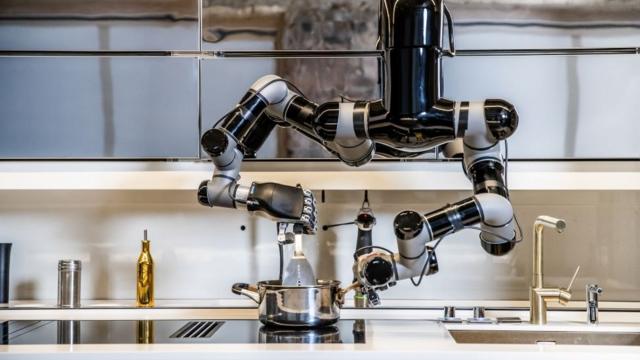
A British company has created a kitchen that can automate cooking and cleaning without human help. The robot uses sensors and cameras to identify ingredients and tools.
Special markers help the robot orient objects correctly. By capturing professional chefs’ movements, the system reproduces human cooking techniques.
DEVELOPED ARTICLE (B1–C2)
Using digital replication, Moley Robotics transformed human skills into mechanical movement. The kitchen adapts to available ingredients and can suggest meals automatically.
This form of domestic automation could become more common as production increases and costs fall, making scalable technology more accessible to households.
COMPREHENSION CHECK
A1–A2
1. Can the kitchen cook food by itself?
2. Does the robot use sensors?
3. Can it clean after cooking?
B1–B2
1. How does the robot know where objects are?
2. Why were chefs involved in development?
3. What tasks can the kitchen automate?
C1–C2
1. How does digital replication improve cooking accuracy?
2. Why is scalability important for this technology?
3. What challenges could limit adoption?
SPEAKING
A1–A2 — FOUNDATION
Language Support:
“I would like ___.”
“I think ___ is useful.”
“I don’t trust ___ because ___.”
PERSONAL QUESTIONS
1. Would you like a robot kitchen?
2. Do you enjoy cooking meals?
3. Is cleaning the kitchen annoying?
4. Do you trust machines at home?
5. Do robots save time?
6. Would you use automation daily?
7. Is cooking a skill everyone needs?
8. Do machines reduce stress?
9. Do you cook often?
10. Do you prefer home-cooked food?
11. Would you miss cooking yourself?
12. Are robots helpful or risky?
13. Do you enjoy new technology?
14. Is convenience important to you?
15. Would you buy this kitchen?
B1–B2 — EXPANSION
Language Support:
“In my opinion…”
“One advantage is…”
“However, a drawback is…”
PERSONAL QUESTIONS
1. How could automated kitchens change daily life?
2. Would automation improve work-life balance?
3. Are robots reliable in domestic settings?
4. What household task should be automated first?
5. Could automation reduce cooking skills?
6. Would price limit adoption?
7. How important is human creativity in cooking?
8. Do smart homes increase comfort?
9. Would you trust AI recommendations?
10. How could kitchens adapt to diets?
11. Would automation reduce food waste?
12. Are robots practical or luxury items?
13. Would you share recipes digitally?
14. Do robots change family routines?
15. Should homes rely on technology?
C1–C2 — DEPTH & REFLECTION
Language Support:
“This raises questions about…”
“From an ethical perspective…”
“One long-term implication is…”
PERSONAL QUESTIONS
1. How might domestic automation reshape human habits?
2. Could reliance on robots reduce self-sufficiency?
3. Should automation prioritize efficiency or creativity?
4. What ethical concerns arise from robotic labor?
5. How might automation affect employment?
6. Should access to automation be regulated?
7. Can robots truly replicate human intuition?
8. Does convenience justify loss of skill?
9. How might AI reshape food culture?
10. Should technology replace traditional skills?
11. Is automation inevitable in daily life?
12. How can humans stay relevant alongside AI?
13. Could automation widen social inequality?
14. How should consumers adapt to rapid innovation?
15. What role should humans retain in the kitchen?